An insole may feel soft when pressed with the fingers and still behave differently from what is expected during use.
Another may offer greater resistance to compression, recover its shape differently, or preserve certain properties better after prolonged loading.
Which one delivers the most appropriate performance?
The answer depends on the function the insole needs to fulfill.
In the footwear industry, terms such as softness, cushioning, and comfort are part of product development language. But to guide the selection of a polyurethane system, these perceptions need to be related to properties that can be technically evaluated.
The challenge is not to find the foam with the greatest number of highlighted features. It is to identify which properties really matter for the application.
Initial softness is not a complete specification
The feeling of softness is one of the first characteristics perceived when someone comes into contact with an insole.
It may influence the initial evaluation of the product, but it does not describe its entire behavior.
An insole needs to respond to different conditions of compression, deformation, and use. Its contribution to the user experience also depends on the footwear construction, geometry, and interaction with other components.
For this reason, a request such as “we need a more comfortable insole” should be translated into engineering questions.
Is the project looking for a softer response to initial compression? A specific elastic recovery? Lower residual deformation after a defined load? Resistance to humidity and temperature conditions?
Each objective requires a different evaluation.
This definition is what makes it possible to transform an expectation of comfort into development requirements.
Resilience: returning energy does not necessarily mean greater comfort
Resilience is related to the material’s ability to return energy after deformation, according to the conditions of the test method used.
In polyurethane systems, different structures and formulations can produce different elastic responses.
This helps explain why materials with a similar appearance may behave differently when compressed.
However, higher resilience should not automatically be interpreted as superior performance.
Some projects may seek a more elastic response. Others may prioritize a more damped behavior, associated with different mechanisms of deformation and energy dissipation.
Amino’s portfolio includes these possibilities.
Within the microcellular AMIPOL PSI + AMIPRE PSI family, the catalog presents one alternative for injected insoles described as having high resilience and another with viscoelastic behavior.
This distinction is important because it shows that development may follow different mechanical objectives even within the same production route.
The question is not which material has the highest resilience, but which response is appropriate for the project.
Compression set: how does the insole respond after being compressed?
An insole may show interesting characteristics when new and change its behavior after remaining under certain loads.
Compression set is a property used to evaluate the residual deformation of a material after a defined compression and recovery condition.
It should not be confused with resilience.
While resilience is related to energy recovery in a specific test, compression set helps assess the ability to recover dimensionally after a defined load.
This distinction matters in projects where preserving thickness, geometry, or certain mechanical characteristics is relevant.
In Amino’s catalog, low deformation is listed among the characteristics of systems intended for insoles, such as AMIPOL BVE + AMISO BVE and AMIPOL PSI + AMIPRE PSI.
However, the practical meaning of this characteristic depends on the evaluation conditions and the acceptance criteria defined for each product.
For this reason, development should consider not only the initial behavior of the foam, but also its response after the tests relevant to the application.
Impact absorption: why are softness and cushioning not synonymous?
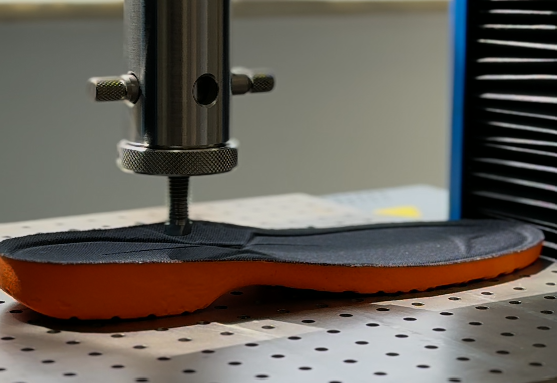
A foam that feels soft to the touch does not necessarily provide the desired response under dynamic loading.
Impact response depends on how the material deforms and how energy is distributed, dissipated, or transmitted under the evaluated conditions.
Foam structure, PU composition, thickness, and component geometry can influence this behavior.
That is why a slow-compression evaluation does not automatically replace a dynamic test.
The microcellular AMIPOL PSI + AMIPRE PSI family, intended for injected insole production, is described in Amino’s catalog as having impact absorption characteristics.
This information is relevant for guiding development, but by itself it does not allow the conclusion that a particular insole will provide greater comfort or specific biomechanical benefits.
These conclusions depend on evaluation of the final component and, when applicable, additional evidence.
For engineering, the central point is to define which behavior needs to be assessed and select a method that is consistent with that objective.
Tear resistance: a property that also matters before use
When discussing insole performance, attention is often focused on softness, compression, and recovery.
But the material also needs to have integrity compatible with its manufacturing process.
This is particularly important in routes that involve producing foam in block form and transforming it afterward.
Cutting, shaping, and handling operations may place mechanical demands on the material. Tear resistance therefore becomes a relevant property when evaluating the foam.
In Amino’s catalog, this characteristic appears in two platforms intended for block-produced insoles.
The AMIPOL PFF + AMISO IFF combination is described as providing high support and tear resistance.
The viscoelastic AMIPOL BVE + AMISO BVE system combines high load-bearing capacity, low deformation, and good tear resistance.
These characteristics show that the specification of an insole should not consider only the sensation during use.
The material must also be compatible with the requirements of the selected production route.
Amino’s catalog highlights good hydrolysis resistance in the microcellular AMIPOL PSI + AMIPRE PSI alternatives intended for injected insoles.
This characteristic, however, should not automatically be converted into a service-life claim.
To interpret performance, it is necessary to know the test conditions, exposure time, and which properties were evaluated after conditioning.
Ageing resistance needs to be analyzed according to the environment and expected requirements of the final product.
How can these properties be brought together in a consistent specification?
The challenge in development is not to maximize every indicator.
An insole with high resilience is not necessarily more suitable than a viscoelastic one. A foam with lower residual deformation does not, by itself, solve all performance requirements. And tear resistance may have different importance depending on the production route.
The manufacturer needs to define priorities.
For one project, dynamic response may deserve greater attention. For another, the ability to preserve certain properties after compression or environmental exposure may be decisive.
What matters is that each requirement is associated with an evaluation method and an acceptance criterion that is compatible with the application.
What should be evaluated before approving a PU system for insoles?
A technically consistent specification starts with the intended function of the component.
From there, Engineering and R&D can identify which properties need to be evaluated and which tests are relevant.
The table below helps organize this decision.
| Property | Technical question | What the evaluation helps to understand |
|---|---|---|
| Resilience | What level of energy recovery is desired? | Elastic response under defined conditions |
| Compression set | Does the material recover its geometry after compression? | Residual deformation after a defined load |
| Impact absorption | How does the component respond to dynamic loading? | Mechanical behavior under impact |
| Tear resistance | Does the material withstand the loads relevant to manufacturing and use? | Resistance to tear propagation |
Test methods, test conditions, and acceptance limits should be defined according to the application. There is no single set of values that determines ideal performance for all insoles.
Amino engineering starts with the needs of the application
Amino offers polyurethane platforms developed for different insole processes and requirements.
These include flexible foam systems for block production, viscoelastic alternatives, and microcellular technologies intended for injection.
Each family has its own characteristics, which need to be considered within the product concept.
Selection can begin with an already developed technology, followed by technical evaluation and validation of its suitability for the process and required properties.
When necessary, Amino can also support the development and customization of solutions, taking production conditions and customer objectives into account.
This approach makes it possible to discuss comfort and performance more objectively, connecting material properties, manufacturing process, and application requirements.
Comfort needs to be translated into verifiable performance
An initial evaluation by touch can help compare sensations between materials, but it does not replace a technical specification.
Likewise, a single result for resilience, density, or compression does not fully describe the behavior of an insole.
The most consistent decision considers the full set of relevant properties, the evaluation methods, and the intended function of the component.
It is this combination that makes it possible to transform an expectation of comfort into an engineering project.
If your company is developing a PU insole or reviewing the performance requirements of an existing product, talk to Amino’s technical team to evaluate the available technologies and development possibilities for your application.