Two polyurethane insoles may look similar and serve comparable end uses. Even so, they may require completely different chemical systems and manufacturing processes.
One may be produced from a foam block that is later cut and converted into the final component. Another may acquire its geometry directly inside the mold during the reaction of a microcellular PU system.
This difference is not limited to the manufacturing method. It influences the properties that need to be prioritized, process control, and product development possibilities across different densities, softness levels, and resilience profiles.
For the footwear industry, this decision is relevant: before selecting the polyurethane system, it is necessary to understand how the insole will be produced and what behavior it will need to deliver inside the footwear.
Slabstock production and injection: two routes, different requirements
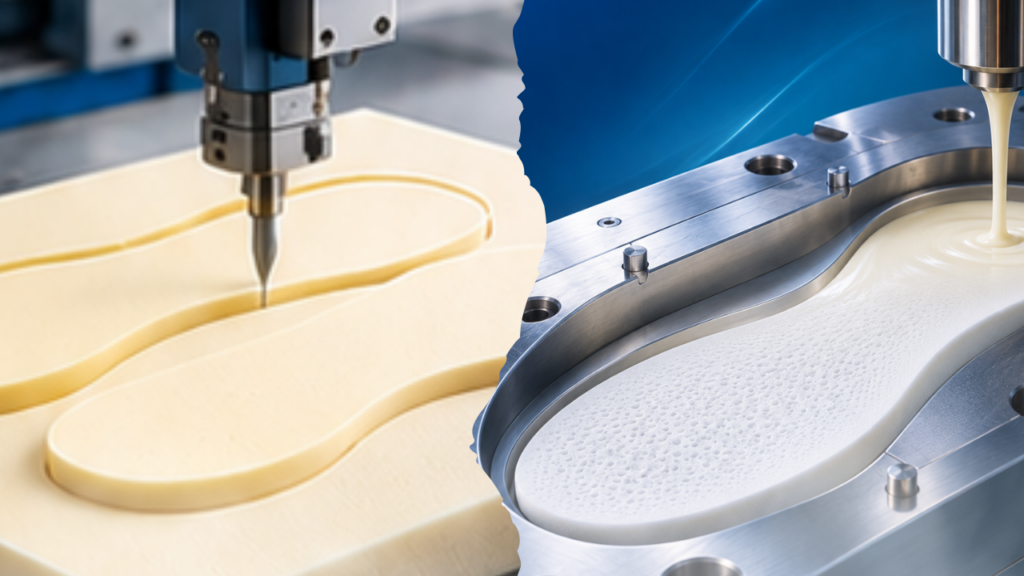
In slabstock production, the polyurethane system first forms a larger volume of foam. This material subsequently goes through cutting operations and, depending on the design, other transformation steps until it reaches the desired geometry.
In this route, the foam characteristics need to be compatible both with the final application and with downstream processing.
Properties such as load-bearing capacity, tear resistance, and deformation behavior become relevant because the material needs to preserve its integrity during both transformation and use.
In injection production, the scenario is different.
The microcellular system reacts inside the mold, allowing material formation and geometry definition to occur in an integrated way.
In this case, development needs to consider filling capability, reaction progression, and consistent reproduction of the part characteristics.
The choice between these two routes is not simply a preference for a specific type of equipment. It defines which requirements the chemical system will need to meet.
What changes when selecting the polyurethane system?
Amino’s portfolio reflects these differences in processing.
For injection-molded insoles, the microcellular AMIPOL PSI + AMIPRE PSI family includes systems with characteristics such as resilience, impact absorption, low deformation, and hydrolysis resistance, depending on the version considered.
The choice depends on the manufacturing route and on the properties required for the application.
It is precisely this diversity that allows engineering teams to start from technologies that have already been developed and evaluate which one offers the greatest compatibility with the project.
Insole geometry is also part of the specification
Imagine developing an insole with different thicknesses between the heel and forefoot areas.
In slabstock production, this geometry will be obtained through operations performed after foam formation. The design needs to consider the possibilities and limitations of this transformation.
In molded production, the geometry can be incorporated into the mold, but the system needs to form the part properly across its different regions.
This means that the same design intention may lead to different decisions regarding material and processing.
It also means that evaluating a flat foam sample in isolation may not represent all the requirements of the final component.
Geometry affects the way the insole deforms and responds to mechanical loads. For this reason, it must be considered together with material properties and manufacturing conditions.
The formulation needs to be compatible not only with the desired foam, but also with the actual part that will be produced.
Why is density not enough to determine the choice?
Density is an important reference when specifying polyurethane foams.
It relates the mass to the volume of the material and plays a role in decisions involving raw material consumption and component construction.
However, density alone does not describe the material’s mechanical response.
Two foams with similar densities may show differences in support, tear resistance, resilience, and compression set.
These properties depend on the composition and structure of the material, as well as on the conditions under which they are evaluated.
Amino’s own portfolio illustrates this diversity: technologies for slabstock insoles and injected microcellular alternatives present different density ranges and performance characteristics.
This does not mean that one range is superior to another. It means that each technology needs to be interpreted within its specific application.
For engineering teams, the most consistent approach is to start from the component requirements and then evaluate the appropriate density, rather than using density as the only criterion for system selection.
The process also influences the real cost of the insole
The decision between slabstock and injection has economic consequences that go beyond the price of polyurethane.
In slabstock production, the manufacturer needs to consider transformation steps, material utilization, and losses associated with obtaining the final geometry.
In molded production, factors such as mold investment, productivity, repeatability, and system utilization during manufacturing become part of the analysis.
Neither route is necessarily more economical in every situation.
The result depends on scale, part complexity, available equipment, and quality requirements.
For this reason, comparing only the cost per kilogram of raw material may lead to an incomplete decision.
The most relevant indicator is the cost of producing an insole that meets the specifications, taking the entire process into account.
From developed technology to the reality of the production line
Selecting a PU system does not need to start from scratch.
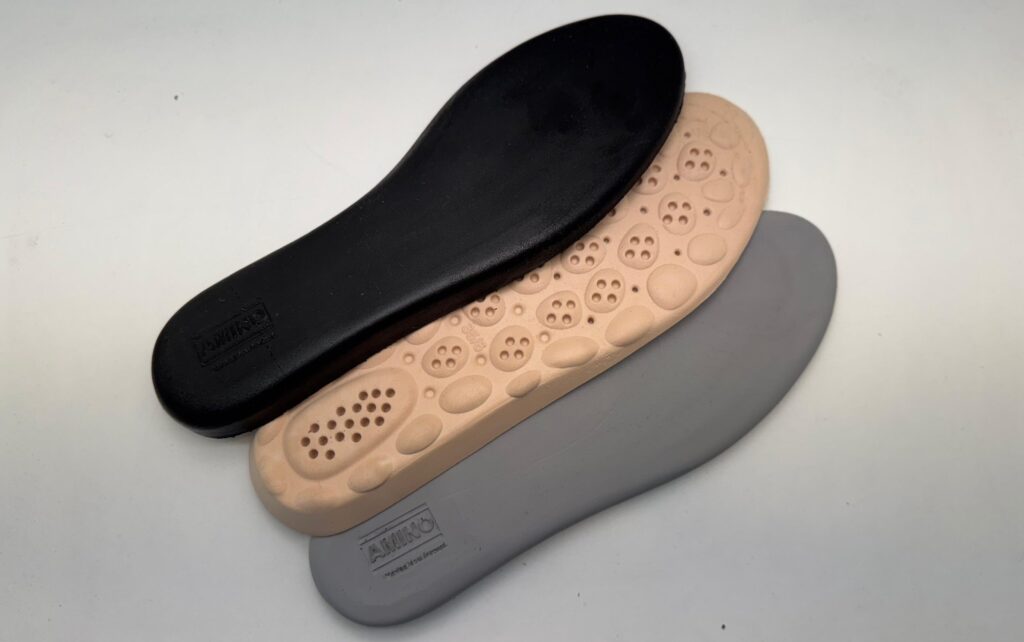
Amino offers platforms developed for different insole manufacturing routes, including flexible and viscoelastic slabstock foams and microcellular injection systems.
This technological base makes it possible to begin the evaluation from existing solutions, considering their compatibility with production conditions and customer requirements.
When necessary, development work may involve adjustments and validations related to equipment, geometry, processing conditions, and desired properties.
The differentiator lies not only in the availability of different chemical families, but also in the ability to connect these technologies to manufacturing needs.
For the manufacturer, this helps structure the decision before moving forward with industrial trials.
The choice starts with the process, not with the name of the foam
When developing a new insole, it is worth clarifying a few points before selecting the system.
Will production be carried out using slabstock or injection? Does the geometry require downstream transformation steps? Which mechanical properties are the highest priority? How will the component be evaluated? What limitations and opportunities exist in the production line?
These answers help identify the technology that is most consistent with the application and reduce the risk of selecting a material based on a single isolated characteristic.
In insole engineering, chemistry, process, and performance need to be considered together.
If your company is developing a new insole or evaluating changes to the production process, talk to Amino’s technical team to assess the available PU technologies and their suitability for your project requirements.r the opportunity lies in the system, the process, or the interaction between both.