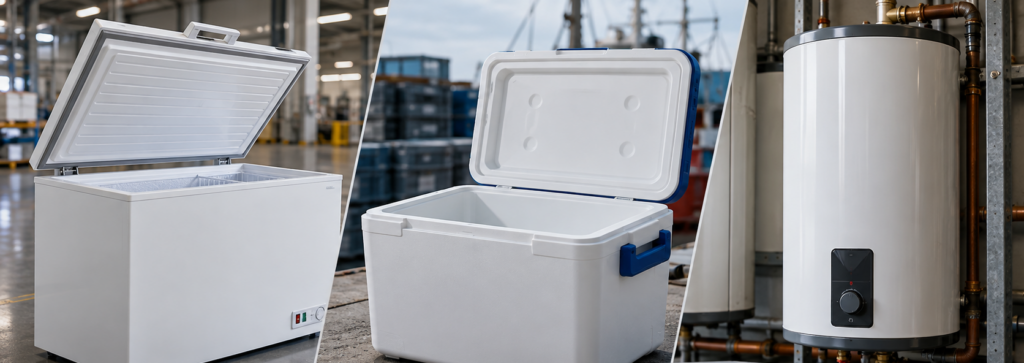
A refrigerator, a freezer, a cooler box, and a boiler have something in common: they all need to control heat transfer.
That does not mean they impose the same challenge on polyurethane.
A long, narrow cavity, a geometry with thickness variations, or equipment operating within a specific production window may require different system behaviors during foam formation.
That is why, when discussing rigid PU systems for thermal insulation, starting the specification process based only on density or thermal performance may leave an important part of the engineering analysis aside.
Before asking which system to use, it is necessary to understand where and how it will need to perform.
Thermal insulation is not a single application
In the finished product, the role of the rigid core may seem quite straightforward: to help reduce heat transfer.
In production, however, the challenge is more complex.
Before becoming the insulating material we know, the system needs to be processed, react, expand, and fill a real geometry.
This is where the differences between applications begin to emerge.
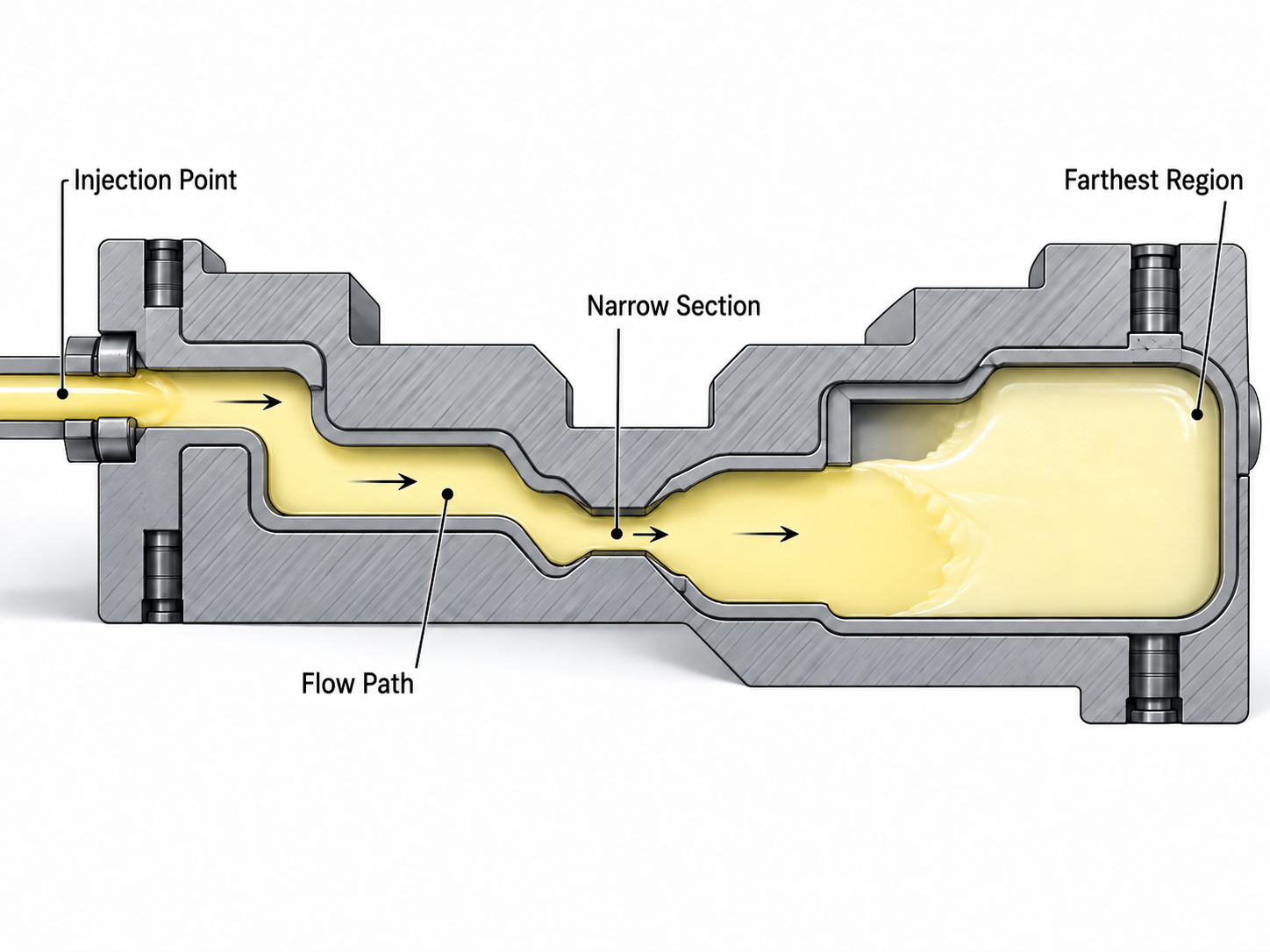
Imagine, for example, a cavity with narrow sections, obstacles, or a relatively long path between the material entry point and the most distant region.
The challenge is not simply to make the foam expand until it occupies that volume.
The system needs to retain enough mobility to move through the geometry while the chemical reaction progresses.
If this balance is not achieved, trying to correct the result simply by increasing the amount of material may mask part of the problem, but it does not necessarily solve its root cause.
This is one of the reasons why geometry and process conditions need to be considered when selecting the system.
Geometry changes the filling challenge
When polyurethane is applied inside a cavity, the material does not encounter an abstract space.
It encounters corners, section changes, distances, obstacles, and surfaces.
These characteristics affect the path the system needs to travel before the progress of the reaction reduces its ability to move.
This is where flowability and reaction profile need to work together.
Simply saying that a system has “good flowability” is not enough.
The industrially relevant question is different:
Does it provide the flow behavior required to fill this geometry under the conditions of this process?
This distinction is important because a solution that performs well in one specific configuration should not automatically be considered ideal for another.
The actual part becomes part of the formulation engineering process.
When filling does not simply mean occupying space
There is another important distinction.
Visually, a cavity may appear to be filled. That alone does not mean that the material was distributed in the most appropriate way across all regions.
Process conditions, geometry, applied mass, and expansion dynamics may contribute to local differences.
For this reason, technical evaluation needs to go beyond simply confirming that “the foam reached the end.”
What matters is the consistency with which the core is formed and its ability to deliver the properties required for that application.
This is exactly the topic we will explore in greater depth in the next content of this series.
Lower density is only a benefit when everything else continues to work
Density deserves special attention because it connects engineering and business considerations very directly.
Using less material can represent a significant economic opportunity.
But there is one condition:
the system still needs to deliver what the application requires.
If a density reduction compromises filling or transfers variability into the production process, part of the savings may reappear in the form of process adjustments, productivity losses, rework, or scrap.
For this reason, density should not be treated simply as a number to be reduced.
It needs to be evaluated within the balance between material usage, core formation, and industrial performance.
This is a particularly important discussion for Purchasing, Production, and R&D, because each area tends to see a different part of this equation.
What about thermal performance?
It remains essential.
But it does not exist in isolation either.
The performance of a rigid system is related to the structure that is formed and to the conditions under which the material was processed.
This means that a technically consistent specification needs to connect what happens during manufacturing with what is expected during product use.
In practice, the solution needs to perform in two environments:
in the factory and in the final application.
This connection is what makes rigid system selection an engineering decision — and not simply a comparison of properties on a technical data sheet.
Where does the experience of a systems house come in?
This is where application knowledge begins to carry as much value as formulation expertise.
Amino works with rigid systems for different thermal insulation applications, including refrigeration equipment and other structures that require control of flow, filling, and stability.
When a new project or improvement need arises, the analysis does not necessarily have to begin from a blank sheet of paper.
Previously developed solutions, past results, and accumulated knowledge from similar applications provide a technical foundation. From there, geometry, equipment, production conditions, and final requirements help determine whether an existing solution fits the scenario or whether adjustments are needed.
This approach makes customization a consequence of the application rather than an end in itself.
The best specification starts with the right questions
When evaluating a rigid system for thermal insulation, it is natural to ask about density, thermal properties, or productivity.
But some of the most important questions come first:
What geometry needs to be filled?
How will the material be applied?
Which regions of the part are the most critical?
What is the production dynamics of the line?
And which properties need to be preserved in the final product?
The answers help transform a generic specification into a decision that is connected to industrial reality.
Because different products may share the same thermal insulation objective.
The path to achieving it does not necessarily have to be the same.
Are you evaluating a new thermal insulation application, geometry, or process condition? Amino’s technical team can support you in selecting and customizing the solution for the reality of your operation.